Forex trading is often marketed online as an opportunity to make money from currency movements. Trading platforms, social-media influencers and online advertisements can make the process look simple: choose a currency pair, predict whether the price will rise or fall, and potentially earn a profit.
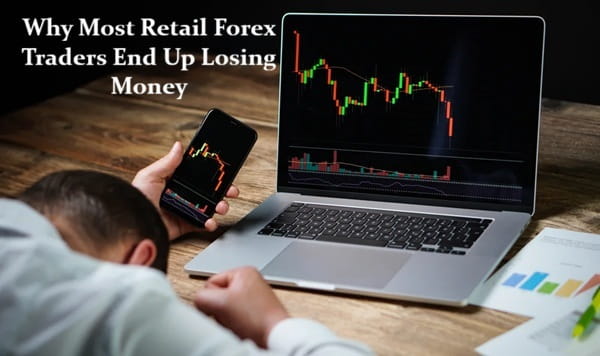
The reality is considerably more difficult. Most retail forex traders struggle to remain profitable over time, particularly when they use leverage and trade frequently. The problem is not simply that traders make a few bad predictions. A combination of leverage, transaction costs, emotional decisions, inadequate risk management and unrealistic expectations can gradually turn small mistakes into significant losses.
Understanding these factors is important for anyone considering forex trading.
1. Leverage Magnifies Losses
One of the biggest reasons retail traders lose money is leverage.
Leverage allows traders to control a position larger than the amount of money deposited in their account. This can increase the impact of relatively small currency movements.
For example, suppose a trader has ₹20,000 and uses leverage to control a position worth ₹2,00,000. A 2% adverse movement would represent a ₹4,000 loss, equal to 20% of the original capital.
Leverage therefore creates a situation in which traders can lose substantial amounts without the currency pair making an unusually large move.
The US Commodity Futures Trading Commission (CFTC) warns that retail forex trading is highly risky and states that approximately two out of three retail forex traders lose money each quarter at US forex dealers.
2. Beginners Often Risk Too Much on One Trade
A common mistake is treating every trade as an opportunity that must produce a large return.
A trader may risk a significant percentage of their account on a single position because they are confident about a particular currency pair.
The problem is that even a well-researched trade can move in the opposite direction.
If a trader repeatedly risks too much on individual positions, several consecutive losses can severely reduce their account. Once the account becomes smaller, recovering from losses becomes increasingly difficult.
For this reason, position sizing is one of the most important aspects of risk management.
3. Overtrading
Another major problem is overtrading.
Forex markets are available across multiple global sessions, and trading platforms make it easy to open and close positions. This constant availability can encourage traders to take positions simply because the market is moving.
A trader might enter several trades in a single day without having a clear strategy or meaningful market signal.
More trades do not necessarily mean more opportunities. They also mean more exposure to losses and more transaction costs.
A disciplined trader should have a reason for entering a position rather than trading merely because the market is open.
4. Trading Costs Reduce Returns
Every trade has costs.
Depending on the product and provider, traders may pay spreads, commissions, financing charges and other fees.
A strategy that generates small profits on individual trades can become unprofitable after these costs are included.
This is especially important for scalpers and very short-term traders who may execute many transactions.
For example, a strategy that targets only a few pips per trade can be heavily affected by the bid-ask spread and commissions.
Therefore, traders need to evaluate performance after costs rather than looking only at their gross trading results.
5. Emotional Trading
Markets can trigger strong emotions such as fear, greed, frustration and excitement.
A trader may close a profitable position too quickly because they are afraid of losing the gain. The same trader may hold a losing position for too long because they hope the market will reverse.
These emotional decisions can create an unfavourable pattern: taking small profits while allowing losses to become much larger.
Professional risk management attempts to reduce the influence of emotion by establishing rules before entering a trade.
6. Revenge Trading
After a significant loss, some traders immediately attempt to recover their money.
This is known as revenge trading.
For example, a trader loses ₹5,000 and then increases the size of the next position in an attempt to make the ₹5,000 back quickly.
If the next trade also loses money, the trader may increase the position again.
This can create a destructive cycle in which one mistake leads to another. Instead of evaluating what went wrong, the trader becomes focused on recovering losses.
Taking a break after a major loss can be more useful than immediately placing another trade.
7. Unrealistic Expectations
Social media can create unrealistic expectations about forex trading.
New traders may see posts claiming that someone turned a small amount of money into a fortune within a short period. Such examples can encourage the belief that high returns are normal.
In reality, consistently generating large returns while controlling risk is extremely difficult.
A strategy promising guaranteed profits, fixed daily returns or extremely high success rates should be treated with suspicion.
Markets are uncertain, and no legitimate strategy can guarantee that every trade will be profitable.
8. Lack of a Trading Plan
Many beginners start trading before developing a clear plan.
They may not know:
- Why they are entering a trade
- Where they will exit if the trade goes wrong
- How much they are willing to lose
- How large their position should be
- When they should stop trading for the day
- How they will evaluate their performance
Without predetermined rules, decisions can change during the trade.
A written trading plan can help establish entry criteria, exit rules, position sizing and risk limits.
9. Using Too Many Indicators
Another common mistake is assuming that adding more technical indicators will automatically improve trading decisions.
A chart filled with moving averages, oscillators, trend indicators and other tools can actually make decision-making more confusing.
Indicators are tools, not prediction machines.
A trader can use a simple strategy successfully if it has a clear logic and appropriate risk management. Conversely, a complicated strategy can still lose money if the underlying assumptions are wrong.
10. Ignoring Fundamental Events
Forex markets are strongly influenced by economic and political developments.
Interest-rate decisions, inflation reports, employment data, central-bank speeches and geopolitical events can cause sudden price movements.
A trader relying exclusively on technical patterns may be caught off guard by a major announcement.
This does not mean every trader needs to become an economist. However, traders should understand the economic calendar and know when major events could affect their positions.
11. Choosing Unregulated or Questionable Platforms
Retail traders can also lose money because of the platform they use rather than simply because of market movements.
Unregulated websites may provide misleading information, impose unexpected restrictions or make withdrawals difficult.
The CFTC advises consumers to verify the registration and regulatory status of forex dealers before depositing funds.
Indian residents also need to consider India’s regulatory framework. The RBI has warned against unauthorised electronic trading platforms offering forex transactions and advises residents to use authorised persons and permitted channels.
12. Failing to Accept Small Losses
Losses are unavoidable in trading.
The goal is not necessarily to win every trade. Instead, a sustainable approach attempts to keep individual losses controlled so that a series of losing trades does not destroy the trading account.
A trader who refuses to accept a small loss may keep the position open while the loss grows.
A predetermined exit strategy can help prevent a manageable loss from becoming a much larger one.
How Retail Traders Can Reduce Their Risk
There is no method that guarantees profits, but traders can improve their decision-making by:
- Using appropriate position sizes
- Limiting leverage
- Understanding all trading costs
- Keeping a trading journal
- Avoiding revenge trading
- Testing strategies before risking substantial capital
- Following a written trading plan
- Monitoring major economic events
- Using regulated and authorised platforms
- Trading only with money they can afford to lose
The objective should be capital preservation and disciplined decision-making, not simply maximising the number of trades.
Conclusion
Most retail forex traders who lose money do not necessarily lose because they cannot predict currency movements. Losses often result from a combination of excessive leverage, poor risk management, overtrading, transaction costs, emotional decisions and unrealistic expectations.
Forex is a highly competitive market in which professional institutions, banks and experienced participants operate alongside retail traders. A beginner therefore needs to approach the market with realistic expectations.
Leverage should be treated cautiously, losses should be controlled, and every trading cost should be considered. Traders should also verify that their broker and trading method are permitted in their jurisdiction.
Ultimately, the most important lesson is that successful forex trading is not about being right on every prediction. It is about managing risk when predictions are wrong. New traders who understand this principle are better positioned to avoid some of the costly mistakes that cause many retail participants to lose money.