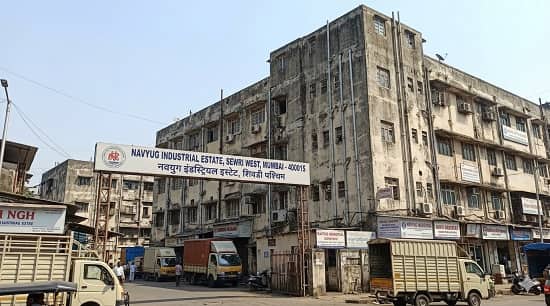
Bharat Industrial Estate is a well-established commercial-industrial complex located in the heart of Sewri West, Mumbai. Spread across a multi-building layout along T.J. Road (Tokarasi Jivaraj Road) near the Datta Mandir, the estate has served as a working business address for decades — housing a practical mix of small-scale manufacturing units, trading firms, packaging operators, warehousing businesses, shipping-linked operations, and service-sector tenants in one of central Mumbai’s most historically industrial belts.
Sewri has a fascinating position in Mumbai’s urban geography. Long anchored by the Mumbai Port Trust, the Sewri-Parel-Lalbaug corridor historically formed the heart of Mumbai’s industrial economy — home to textile mills, shipping operations, and the docks that once made Bombay India’s commercial capital. Over the past two decades, the neighbourhood has been quietly transforming, with the Mumbai Trans-Harbour Link (Atal Setu) now operational, the upcoming Sewri metro connectivity, and redevelopment activity bringing fresh commercial energy. Bharat Industrial Estate has maintained its working character through this transformation, continuing to serve as a practical base for businesses connected to Mumbai’s port, logistics, and traditional industrial economy.
| Category | Details |
| Location | T.J. Road, Near Datta Mandir, Sewri West, Mumbai |
| State | Maharashtra |
| Industrial Estate | Bharat Industrial Estate |
| PIN Code | 400015 |
| Type | Mixed Industrial & Commercial Estate |
| Major Industries | Manufacturing, Port-linked, Trading, Packaging, Warehousing, Offices |
| Distance from BKC | Approx. 8-10 km |
| Nearby Airport | CSMIA Mumbai, approx. 16-18 km |
| Major Roads | T.J. Road, Dr Babasaheb Ambedkar Road, Eastern Freeway, Reay Road |
| Nearby Landmark | Sewri Station, Mumbai Port Trust, Atal Setu, Lalbaug |
Overview of Bharat Industrial Estate
Bharat Industrial Estate is a long-established commercial-industrial complex located on T.J. Road in Sewri West, close to the Datta Mandir and well within walking distance of Sewri Railway Station. It consists of small to medium-sized units catering to a diverse range of businesses — from light manufacturing and trading to packaging, warehousing, shipping-linked services, and corporate offices.
The layout follows the classic older Mumbai industrial premises format. Commercial spaces at the estate range from compact 1,000 sq ft units to substantially larger 7,520 sq ft configurations, giving businesses significant flexibility depending on their scale. Buildings are functional rather than ultra-modern, organised into blocks with units distributed across multiple floors.
What makes the estate distinctive is its location within Mumbai’s historic industrial corridor. Sewri’s proximity to the Mumbai Port Trust has shaped the neighbourhood’s commercial character for over a century, and Bharat Industrial Estate has inherited that practical, port-adjacent identity. Several businesses operating out of the estate have direct or indirect links to shipping, customs, freight forwarding, and port logistics — creating a genuine commercial ecosystem.
Location and Connectivity
Connectivity is one of Bharat Industrial Estate’s practical strengths. Its Sewri West location places it at a historically important junction of central Mumbai.
Road access is strong. The estate sits on T.J. Road, with immediate links to Dr Babasaheb Ambedkar Road, Reay Road, and Katrak Road. The Eastern Freeway — a major elevated highway connecting South Mumbai to Chembur and the eastern suburbs — is easily accessible, dramatically reducing travel times to Ghatkopar, Vikhroli, and the Eastern Express Highway.
The Mumbai Trans-Harbour Link (Atal Setu), now operational, has been genuinely transformative. This 22-km sea bridge connects Sewri directly to Nhava Sheva (JNPT) and the broader Navi Mumbai belt, reducing travel times to the port, Navi Mumbai International Airport (under construction), and the Thane belt. For businesses with port linkages or Navi Mumbai operations, this is a major upgrade.
For rail, Sewri Railway Station on the Harbour Line is within walking distance — one of the best rail-connected industrial estates in Mumbai. The Harbour Line provides direct services to CST, Panvel, and onward to Navi Mumbai. Cotton Green and Reay Road stations are also close by. Currey Road on the Central Line is within short drive.
The metro story is developing. Sewri metro station on Mumbai Metro Line 11 (Wadala-CSMT corridor), currently under construction, will add significant connectivity when operational. Mumbai Metro Line 4 (Wadala-Thane) is also expected to eventually serve the broader Wadala-Sewri belt.
CSMIA airport is approximately 16-18 km away, typically 35-45 minutes by road. BKC sits about 8-10 km away.
Business and Commercial Importance
Bharat Industrial Estate plays a practical role in Mumbai’s central commercial ecosystem. It supports the kind of businesses that value genuine operational connectivity over premium corporate aesthetics.
Port and shipping-linked businesses form a distinctive segment. Given Sewri’s proximity to the Mumbai Port Trust — one of India’s oldest and most significant ports — the estate naturally hosts freight forwarders, customs clearance agents, shipping line agencies, logistics coordinators, and port-adjacent trading firms.
Manufacturing and traditional industrial units continue to operate across the estate’s blocks, producing everything from packaging materials and hardware to specialty industrial goods. Several firms in the pharma, chemical distribution, and specialty manufacturing sectors also operate out of Bharat Industrial Estate.
Trading companies dealing in industrial goods, specialty chemicals, imported items, and wholesale products form another significant segment. The combination of port proximity and traditional Mumbai trading culture creates a robust base for import-export businesses.
Over recent years, the profile has begun diversifying. Service-sector businesses — CA firms, legal practices, consulting outfits, digital agencies, and small IT service providers — have started moving into upper-floor units, particularly as Sewri’s broader redevelopment momentum attracts newer commercial tenants. Corporate back-offices of larger firms also use the estate as a cost-effective central Mumbai location.
Nearby Infrastructure and Facilities
The area around Bharat Industrial Estate has a distinctive central Mumbai character, blending old industrial heritage with newer commercial developments.
Sewri itself is known for the Sewri Fort, the Mumbai Port Trust complex, and the famous Sewri mudflats that host thousands of flamingos during the winter migration. The Datta Mandir near the estate is a local landmark that gives the immediate area its identity.
Healthcare is strong. Tata Memorial Hospital (one of India’s premier cancer treatment centres), KEM Hospital, Wadia Hospitals, and Nair Hospital are all within short drive. This concentration of major healthcare institutions is a practical advantage for businesses and their employees.
Food options span the full Mumbai spectrum. Sewri-Parel-Lalbaug has some of the city’s most legendary street food, Maharashtrian establishments, and traditional Konkani seafood joints. Cafes and quick-service outlets are plentiful along T.J. Road and the connected arterial routes.
Banks, ATMs, courier services, and industrial supply shops are readily available. Business hotels catering to the central Mumbai commercial belt are within short drive, including ITC Grand Central, The Four Seasons (Worli), and several mid-range options in Lower Parel.
Retail destinations are accessible. Phoenix Mills and High Street Phoenix are about 4-5 km away in Lower Parel. Educational institutions in the broader Parel-Dadar belt provide a steady workforce pool. Residential neighbourhoods in Sewri, Wadala, Parel, and Matunga house much of the estate’s workforce.
Advantages of the Location
Rail connectivity is one of the single biggest advantages. Sewri Railway Station on the Harbour Line is within walking distance of the estate, giving tenants access to direct services to CST, Panvel, Navi Mumbai, and the wider Mumbai suburban rail network.
Port proximity is genuinely strategic. Mumbai Port Trust and the associated shipping, customs, and freight ecosystem give the estate a commercial edge for logistics-linked and trading businesses that few other Mumbai industrial estates can match.
The Atal Setu (Mumbai Trans-Harbour Link) has been transformative. Direct sea bridge connectivity to Navi Mumbai, JNPT port, and the eastern mainland has dramatically improved operational logistics for businesses with cross-harbour activities.
Central Mumbai positioning adds real value. Being in the Sewri-Parel-Wadala belt means tenants can serve clients across South Mumbai, BKC, and the central business districts from a single base.
Affordability relative to Lower Parel, Worli, or BKC is a genuine draw. Bharat Industrial Estate offers a central Mumbai address at meaningfully more approachable rates than premium Grade-A developments just a few kilometres away.
The Eastern Freeway’s proximity provides fast access to Chembur, Ghatkopar, and the eastern suburbs — a practical connectivity edge for businesses with operations spread across Mumbai.
Challenges or Limitations
Infrastructure, while functional, isn’t modern. Buildings show their age, and finishes can feel dated compared to newer commercial towers in Lower Parel or BKC. For firms targeting high-end corporate or international clients, the older premises character can occasionally be a limitation.
Traffic congestion is a recurring concern. T.J. Road, Dr Babasaheb Ambedkar Road, and the approaches to the Eastern Freeway experience heavy congestion during peak hours. The broader Sewri-Parel belt can be slow-moving, particularly during monsoon or festival seasons.
Parking is genuinely tight. Like most older central Mumbai industrial estates, Bharat wasn’t designed for current vehicle volumes, and street-side space is often contested between tenants, visitors, and delivery trucks.
Monsoon waterlogging is a serious recurring issue. The Sewri-Wadala-Parel belt includes some of Mumbai’s most flood-prone stretches during heavy rain, occasionally causing significant disruption to operations and logistics.
Neighbourhood character is mixed. While Sewri’s ongoing redevelopment is changing the area, the immediate surroundings of Bharat Industrial Estate retain the gritty, working-class industrial feel of old central Mumbai — which some premium tenants may find unsuitable for their client-facing operations.
FAQs
Q1. What is the PIN code of Bharat Industrial Estate?
The estate falls under PIN code 400015, covering the Sewri West commercial belt.
Q2. Where exactly is Bharat Industrial Estate located?
It is located on T.J. Road (Tokarasi Jivaraj Road), near the Datta Mandir in Sewri West, Mumbai.
Q3. What kind of businesses operate at Bharat Industrial Estate?
A diverse mix of port and shipping-linked firms, freight forwarders, customs clearance agents, manufacturing units, packaging firms, trading companies, warehousing operators, CA offices, and professional service tenants.
Q4. What unit sizes are available?
Commercial spaces range from 1,000 sq ft to 7,520 sq ft, giving businesses substantial flexibility.
Q5. What is the nearest railway station?
Sewri Railway Station on the Harbour Line is within walking distance — one of the best rail-connected industrial estates in Mumbai.
Q6. How far is Mumbai Port Trust?
Mumbai Port Trust is immediately adjacent to the Sewri belt, making Bharat Industrial Estate one of Mumbai’s most port-proximate commercial addresses.
Q7. Is Bharat Industrial Estate a good choice for logistics and shipping businesses?
Yes, exceptionally so. The combination of Sewri Station, Mumbai Port Trust proximity, Eastern Freeway access, and the Atal Setu (Mumbai Trans-Harbour Link) makes it ideal for freight, shipping, customs, and logistics-linked firms.
Q8. What are the main challenges of operating here?
Older building infrastructure, peak-hour traffic on T.J. Road, limited parking, monsoon-season waterlogging, and the traditional industrial character of the surrounding area are the most commonly cited concerns.