Paper trading is a popular way for beginners to practise trading without risking real money. It allows users to buy and sell stocks, futures, options, or other financial instruments through a simulated account. Because no actual capital is at risk, paper trading can help traders understand market movements, test strategies, and become familiar with trading platforms.
However, many traders discover that a strategy that performs well in a simulated environment produces different results when used with real money. This difference occurs because paper trading cannot perfectly reproduce every aspect of live financial markets, particularly execution costs, liquidity constraints, emotional pressure, and unexpected price movements.
Understanding these differences is essential for anyone preparing to move from simulated trading to a live account.
What Is Paper Trading?
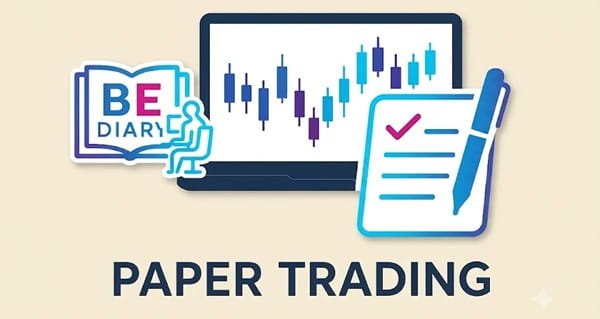
Paper trading is the practice of simulating financial transactions without using actual money. Traders can test entry and exit rules, practise order placement, and monitor hypothetical profits or losses.
For example, a trader may purchase 100 shares at a simulated price of ₹200 and sell them later at ₹210. The platform may display a hypothetical profit of ₹1,000 before costs.
In live trading, however, the order may execute at different prices, brokerage and other charges may apply, and the trader may make different decisions under emotional pressure. Consequently, the simulated profit does not necessarily represent the amount that could have been earned in a real account.
Differences in Order Execution
One major reason paper trading results differ from real trading outcomes is order execution.
Simulated platforms may assume that an order executes at the displayed market price as soon as a trader submits it. In live markets, execution depends on available buyers and sellers, order type, market conditions, and the speed at which the order reaches the exchange.
A market order may execute at several prices when liquidity is limited. A limit order may remain unfilled if the market never reaches the specified price or if other orders have priority.
During periods of rapid price movement, the difference between the expected execution price and the actual execution price can become significant. This difference is commonly known as slippage.
A paper trading system that assumes perfect execution may therefore overstate a strategy’s profitability.
Trading Costs Reduce Actual Profits
Paper trading results can also appear better because simulated accounts may exclude some or all real-world trading costs.
Depending on the broker, instrument, and jurisdiction, these costs may include brokerage, exchange transaction charges, applicable taxes, regulatory fees, and bid-ask spreads. Derivatives traders may also need to consider other product-specific expenses.
Consider a strategy that generates ₹1,000 in gross profit across several trades. If the total transaction costs are ₹300, the remaining profit is only ₹700, assuming no other expenses or execution differences.
Frequent trading can make these costs especially important. A strategy that appears profitable before expenses may become unprofitable after realistic trading costs are included.
For this reason, traders should evaluate strategies using conservative cost assumptions rather than relying only on gross simulated returns.
Liquidity and Market Impact
Liquidity refers to how easily an asset can be bought or sold without significantly affecting its price. Highly liquid stocks generally have more active buyers and sellers, while less liquid instruments may have wider bid-ask spreads and fewer available orders.
Paper trading platforms may not fully reproduce the limitations of real order books. A simulated strategy might assume that a large order can be executed at one price, even when the live market does not have enough available liquidity.
Large orders can also affect prices, a phenomenon known as market impact. This is particularly relevant to traders handling substantial positions or trading less liquid securities.
A strategy that works with small simulated orders may therefore perform differently when used with larger amounts of real capital.
Emotional Pressure Changes Trading Decisions
Psychology is another important difference between paper trading and live trading.
In a simulated account, losses are hypothetical. Traders may follow their strategies confidently because they know their actual savings are not at risk.
When real money is involved, fear and greed can influence decisions. A trader may exit a profitable position too early, hold a losing trade for too long, increase position sizes after a win, or abandon a strategy after a short losing streak.
These behaviours can significantly affect results, even when the underlying strategy remains unchanged.
Paper trading can help develop procedural discipline, but it cannot fully reproduce the emotional experience of losing real money. Traders need to recognise this limitation when evaluating their readiness for live markets.
Historical Data and Overfitting
Some traders use paper trading to test strategies developed from historical price data. Although backtesting can be useful, it can also produce misleading results if a strategy is excessively tailored to past market behaviour.
This problem is known as overfitting. A strategy may appear highly profitable because it captures random patterns in historical data rather than a repeatable market advantage.
Simulated results can also be distorted by look-ahead bias, survivorship bias, or unrealistic assumptions about order execution.
To reduce these problems, traders should test strategies on data that was not used during development and evaluate performance across different market conditions. They should also account for realistic transaction costs and execution delays.
Market Conditions Can Change Unexpectedly
A strategy may perform well during a stable upward trend but struggle during a sudden market decline or a period of extreme volatility.
Paper trading over a short period may not expose a strategy to enough different conditions. For example, a simulated account that records several profitable weeks may provide little evidence about how the strategy behaves during an economic announcement or a sharp market reversal.
Traders should evaluate strategies across different periods and conditions rather than assuming that a short run of positive results will continue indefinitely.
How to Make Paper Trading More Realistic
Although paper trading cannot perfectly reproduce live trading, traders can use it more effectively by following a disciplined process.
- Include realistic brokerage charges, spreads, and other applicable costs.
- Record potential slippage instead of assuming every order fills at the displayed price.
- Use position sizes similar to those planned for live trading.
- Follow predefined entry, exit, and risk-management rules.
- Test the strategy across different market conditions.
- Maintain a journal of trades, mistakes, and performance.
- Avoid changing rules simply to improve simulated results.
After demonstrating a consistent process, some traders may consider transitioning to a small live position they can afford to lose. This step should be gradual, and simulated success should never be treated as proof of future profitability.
Conclusion
Paper trading is a valuable learning tool, but its results rarely match real trading outcomes perfectly. Execution differences, transaction costs, liquidity, emotional pressure, unrealistic assumptions, and changing market conditions can all affect actual performance.
The best approach is to use paper trading to develop skills and test strategies while recognising its limitations. Traders should evaluate results conservatively, apply realistic risk controls, and avoid committing substantial capital based only on simulated profits.
Frequently Asked Questions
Q. Why is paper trading easier than real trading?
Paper trading removes the financial consequences of losses and may simplify order execution. Without real money at risk, traders may also feel less emotional pressure when making decisions.
Q. Can paper trading guarantee success in live trading?
No. Simulated performance does not guarantee future results because actual execution, trading costs, market conditions, and emotional responses can differ.
Q. How long should I practise paper trading before going live?
There is no universal time requirement. Focus on whether you understand your strategy, have tested it across different conditions, account for costs, and consistently follow your risk-management rules. A short period of profits is not sufficient evidence by itself.
Q. Does paper trading include brokerage charges?
Some platforms allow users to configure estimated costs, while others may exclude them or apply simplified assumptions. Check the platform’s settings and include realistic expenses when evaluating performance.
Q. Is paper trading useful for experienced traders?
Yes. Experienced traders can use it to test new strategies, practise unfamiliar instruments, evaluate platform features, and check changes to trading systems without immediately risking capital.
Q. Should I start live trading after making profits in a demo account?
Not solely because of demo profits. First evaluate the strategy’s risk, costs, execution assumptions, and performance across different market conditions. If you decide to trade live, begin cautiously and use only capital you can afford to lose.