Leverage is one of the most important and misunderstood concepts in forex trading. It allows a trader to control a position that is larger than the amount of money deposited in their trading account. This can increase the potential return from a relatively small price movement, but it can also magnify losses just as quickly.
For beginners, understanding leverage is essential because a trade that appears small can create significant exposure when leverage is involved. Forex trading already carries market risk, and excessive leverage can make that risk substantially greater.
What Is Leverage in Forex Trading?
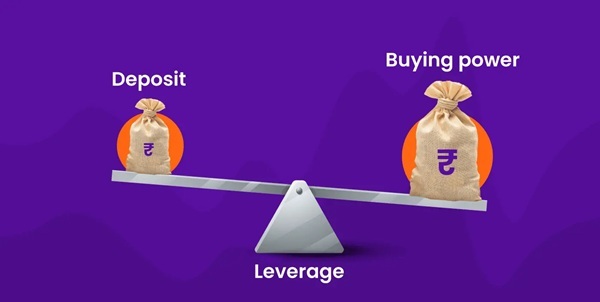
In simple terms, leverage allows traders to control more money than they have deposited as trading capital.
For example, suppose a broker provides leverage of 20:1. A trader with ₹10,000 in available margin could potentially control a position worth ₹2,00,000, subject to the broker’s rules and applicable regulations.
The trader does not receive ₹2,00,000 in cash to spend. Instead, the margin acts as collateral for the larger trading position.
This means that even a relatively small movement in the currency pair can produce a meaningful gain or loss relative to the trader’s own capital.
What Is Margin?
Margin is the amount of money that a trader needs to provide to open and maintain a leveraged position.
Leverage and margin are closely related. If leverage is 10:1, the required margin is approximately 10% of the position’s value. With 20:1 leverage, the required margin is approximately 5%.
For example, if a trader wants to control a position worth ₹1,00,000 using 20:1 leverage, the required margin could be approximately ₹5,000.
The exact requirements depend on the financial product, broker, market conditions and applicable regulations.
Margin should not be confused with a fee. It is generally collateral supporting the position, although losses can reduce the account’s available equity.
A Simple Example of Forex Leverage
Consider a hypothetical trader with ₹10,000 in trading capital.
Without leverage, the trader might take a position worth ₹10,000.
With 10:1 leverage, the trader could potentially control a position worth ₹1,00,000.
Suppose the currency position moves 1% in the trader’s favour.
A 1% movement on ₹1,00,000 represents ₹1,000. Relative to the trader’s ₹10,000 capital, that is a 10% return before costs.
However, if the position moves 1% against the trader, the loss would also be ₹1,000, representing 10% of the original capital.
This demonstrates the central principle of leverage: it magnifies the effect of price movements on the trader’s own capital.
Why Traders Use Leverage
Leverage can have legitimate uses when managed carefully.
Greater Capital Efficiency
A trader does not necessarily need to commit the entire notional value of a position as margin.
Access to Larger Positions
Leverage allows traders to obtain exposure to larger positions with comparatively smaller capital.
Potentially Higher Returns
If the market moves in the trader’s favour, leverage can increase the return on the capital committed to the trade.
However, these advantages do not make leveraged trading safer. The same mechanism that increases potential returns also increases potential losses.
The Major Risk: Magnified Losses
The most important risk of leverage is that losses are magnified.
Imagine a trader has ₹20,000 and uses leverage to control a ₹2,00,000 position. A 2% adverse movement would represent a ₹4,000 loss.
That equals 20% of the trader’s original ₹20,000 capital.
A larger adverse movement could consume a substantial portion of the account.
This is why beginners should avoid thinking about leverage only in terms of how much they can potentially earn. The more important question is how much they could lose if the market moves against them.
Margin Calls and Forced Position Closure
Leveraged trading also introduces the possibility of a margin call or forced position closure.
If losses reduce the trader’s account equity below the broker’s required margin level, the broker may require additional funds or close some or all positions, depending on the applicable rules.
A rapidly moving market can make this happen quickly.
Traders should therefore understand their broker’s margin requirements, liquidation rules and policies concerning negative balances before using leverage.
Leverage and Market Volatility
Currency markets can move sharply following major economic announcements.
Events such as central-bank interest-rate decisions, inflation reports, employment data, unexpected geopolitical developments and major political announcements can cause rapid changes in exchange rates.
A highly leveraged position has less room to withstand such movements.
For example, a trader using very high leverage may be forced out of a position by a relatively small adverse price movement, even if the trader’s longer-term market view eventually proves correct.
Why High Leverage Can Be Dangerous
Online forex platforms sometimes advertise extremely high leverage as an attractive feature.
A beginner may see leverage such as 100:1 or even higher and assume that it provides an opportunity to make money with very little capital.
In reality, high leverage means that a trader can take on substantial market exposure relative to their account size.
The Commodity Futures Trading Commission (CFTC) warns that leveraged forex trading can result in losses exceeding the initial amount deposited in certain circumstances and advises customers to understand the risks before trading.
The exact protections and leverage limits vary by jurisdiction and product, so traders should always check the rules applicable to them.
Risk Management When Using Leverage
Leverage should be combined with disciplined risk management.
Use Smaller Position Sizes
Having access to a large leveraged position does not mean a trader should use the full amount.
Set Stop-Loss Levels
A stop-loss can help define the maximum intended loss on a trade, although it cannot guarantee execution at the exact desired price during fast-moving or illiquid markets.
Avoid Concentrating Capital
Putting most of an account into one leveraged trade can create significant risk.
Understand the Margin Requirement
Traders should know how much margin is required and how much available margin remains after opening a position.
Avoid Trading With Essential Money
Money needed for rent, education, household expenses or emergency savings should not be used for speculative leveraged trading.
The CFTC similarly advises individuals to use only risk capital—money they can afford to lose.
Leverage for Indian Forex Traders
For Indian residents, leverage should also be considered alongside the country’s regulatory framework.
Forex transactions and currency derivatives are subject to rules under FEMA, RBI directions and applicable securities-market regulations. Indian residents should use permitted products and authorised channels rather than assuming that the leverage offered by an offshore forex website is legally available to them.
The RBI has warned residents against unauthorised electronic trading platforms offering forex transactions.
Therefore, regulatory status should be checked before depositing money with a trading platform.
Is More Leverage Better?
Generally, more leverage does not mean a better trading opportunity.
A professional approach focuses on controlling risk rather than maximising the size of a position.
For example, a trader who has access to 50:1 leverage does not have to use the maximum available exposure. They may choose a much smaller position so that a normal market fluctuation does not seriously damage the account.
The goal should be to use leverage as a tool for capital efficiency rather than as a way to amplify every trade.
Conclusion
Leverage allows forex traders to control larger positions with a smaller amount of capital, but it also magnifies losses. Margin provides the collateral required for the leveraged position, while adverse price movements can reduce account equity and potentially trigger margin calls or forced closures.
For beginners, the most important lesson is that leverage should never be judged solely by its profit potential. A highly leveraged trade can lose money just as quickly as it can make money.
Responsible traders understand position sizing, margin requirements, stop-loss strategies, market volatility and regulatory restrictions before using leverage. They also avoid risking money needed for essential expenses.
Ultimately, leverage is neither inherently good nor bad—it is a powerful financial tool whose risk depends on how much exposure a trader takes relative to their available capital. Using less leverage, controlling position size and prioritising capital preservation can help new traders avoid some of the most serious mistakes associated with leveraged forex trading.