Punit Industrial Estate is a well-established commercial-industrial complex located in the heart of Turbhe MIDC, Navi Mumbai. Spread across a practical layout along Thane-Belapur Road near the Turbhe-Sanpada belt, the estate has served as a working business address for years — housing a diverse mix of small-scale manufacturing units, food processing businesses, warehousing operators, trading firms, logistics companies, and service-sector tenants in one of India’s most strategically positioned industrial corridors.
Turbhe MIDC sits at a genuinely pivotal junction in the broader Mumbai Metropolitan Region. The Thane-Belapur industrial belt — spanning from Thane through Turbhe, Mahape, Rabale, and Pawne to Belapur — is one of the largest planned industrial corridors in Maharashtra, developed by the Maharashtra Industrial Development Corporation (MIDC). Punit Industrial Estate sits right along this backbone, benefiting from MIDC infrastructure, proximity to Mumbai, the operational Atal Setu (Mumbai Trans-Harbour Link), the upcoming Navi Mumbai International Airport (NMIA), and direct connectivity to both Mumbai and the rest of Maharashtra via the Mumbai-Pune Expressway and NH-4.
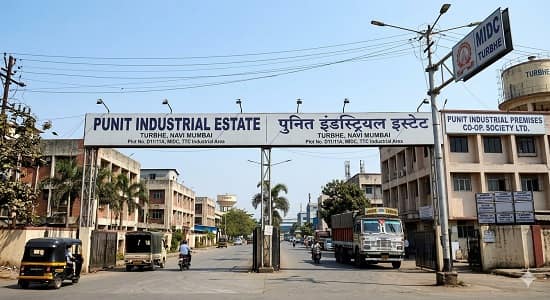
Punit Industrial Estate Quick Overview
| Category | Details |
| Location | Unit C, 110A, Thane-Belapur Road, Turbhe MIDC, Navi Mumbai |
| State | Maharashtra |
| Industrial Estate | Punit Industrial Estate |
| PIN Code | 400705 |
| Developed By | Maharashtra Industrial Development Corporation (MIDC) belt |
| Major Industries | Manufacturing, Food Processing, Warehousing, Trading, Logistics, Offices |
| Distance from Mumbai CST | Approx. 25-28 km |
| Nearby Airport | CSMIA Mumbai, approx. 22-25 km; Navi Mumbai Airport (upcoming) 25-28 km |
| Major Roads | Thane-Belapur Road, Sion-Panvel Expressway, NH-4, Palm Beach Road |
| Nearby Landmark | Vashi Railway Station, Turbhe MIDC, APMC Market, Inorbit Mall Vashi |
Location and Connectivity
Connectivity is one of Punit Industrial Estate’s strongest strategic advantages. Its Turbhe location places it at the intersection of Navi Mumbai’s most important transport corridors.
Road access is exceptional. The estate sits directly on Thane-Belapur Road, the primary arterial route connecting Thane through the entire Navi Mumbai industrial corridor to Belapur and onward to JNPT and Panvel. The Sion-Panvel Expressway is easily accessible, providing fast connectivity to Mumbai via the Sion-Panvel junction. Palm Beach Road offers another high-quality north-south corridor along Navi Mumbai’s waterfront. NH-4 (Mumbai-Pune Expressway access) is within easy reach via the Kalamboli-Panvel junction.
The Atal Setu (Mumbai Trans-Harbour Link), operational since January 2024, has been genuinely transformative. This 22-km sea bridge connects Sewri in central Mumbai directly to Chirle in Navi Mumbai, with Turbhe within practical reach of the MTHL. Travel times from central Mumbai to Turbhe MIDC have dropped substantially, creating new operational advantages for businesses with Mumbai linkages.
For rail, Vashi Railway Station on the Harbour Line is approximately 1.56 km away — about a 5-minute auto ride or 18-20 minute walk. The Harbour Line provides direct services to CST and Panvel, with frequent trains connecting to the wider Mumbai suburban network. Turbhe Railway Station is also nearby, while Nerul, Belapur, and Vashi stations add further options.
Navi Mumbai Metro Line 1 (Belapur-Pendhar) is operational, with stations along the Sanpada-Turbhe-Kharghar corridor improving public transport connectivity. The upcoming Navi Mumbai Metro expansion will further enhance accessibility.
The upcoming Navi Mumbai International Airport (NMIA) at Ulwe is approximately 25-28 km away. Once operational (phased commissioning underway), NMIA will add a massive aviation connectivity dimension. Mumbai’s CSMIA remains about 22-25 km away, reachable via the Atal Setu, Sion-Panvel Expressway, or Eastern Freeway.
JNPT Port at Nhava Sheva, one of India’s largest container ports, is about 25-30 km away via Thane-Belapur Road and Palm Beach Road — a genuine operational advantage for export-oriented manufacturers.
Business and Commercial Importance
Punit Industrial Estate plays a meaningful role in Navi Mumbai’s manufacturing and commercial economy. It supports a diverse range of businesses that form part of the broader Turbhe MIDC productive ecosystem.
Food processing is a notable segment specific to this estate. Meat processing, poultry, and food-linked businesses operate from Punit Industrial Estate — with the location offering the industrial infrastructure, water supply, and waste management systems that food processing requires. This food cluster is part of Turbhe’s broader role in Mumbai’s wholesale food supply chain, reinforced by the massive APMC (Agricultural Produce Market Committee) Market at Vashi-Turbhe that handles fruits, vegetables, grains, and spices for the entire Mumbai region.
Manufacturing and industrial operations form the broader base. Light engineering units, chemical processing (within regulatory limits), plastic and packaging operations, machinery parts manufacturers, and specialty fabrication outfits operate across the estate.
Warehousing, logistics, and distribution are major segments. Turbhe’s strategic position between Mumbai, the JNPT port, the APMC wholesale market, and the upcoming NMIA makes it one of the most logistics-heavy zones in Maharashtra. Large distribution warehouses, e-commerce fulfilment centres, and cold storage facilities operate throughout the broader belt.
Trading companies dealing in industrial goods, hardware, electronics, FMCG, and specialty items form another significant segment. Import-export businesses leverage the port and airport proximity.
Corporate offices and service-sector businesses have grown their presence steadily. CA firms, legal practices, consulting outfits, logistics coordinators, and BPO operations occupy office units across the estate, drawn by the Navi Mumbai business environment and the area’s affordability compared to BKC or Andheri East.
Nearby Infrastructure and Facilities
The Turbhe-Vashi-Sanpada belt is exceptionally well-developed, reflecting Navi Mumbai’s status as one of India’s best-planned urban regions.
Retail is a major strength. Inorbit Mall Vashi, Centre One Mall, Raghuleela Mall, and the Palm Beach commercial corridor offer premium retail, dining, and entertainment options. The APMC Market at Turbhe-Vashi is one of Asia’s largest agricultural wholesale markets, handling billions of rupees in daily produce trade.
Food options are abundant and diverse. Turbhe-Vashi-Sanpada hosts a rich mix of Maharashtrian, Gujarati, South Indian, North Indian, Chinese, and international cuisines. The food scene caters to both the industrial workforce and the premium residential communities of Vashi, Nerul, and Seawoods.
Healthcare is exceptionally strong. Apollo Hospitals Navi Mumbai (Belapur), D Y Patil Hospital (Nerul), MGM Hospital (Vashi), Fortis Hiranandani Hospital (Vashi), and several specialty clinics serve the area. This healthcare density is genuinely world-class.
Banks, ATMs, courier services, and business support outfits are plentiful along Thane-Belapur Road and the Vashi-Sanpada commercial corridor. Business hotels include the Fortune Select Exotica, Four Points by Sheraton Navi Mumbai, Yogi Executive, and numerous mid-range options.
Educational institutions are notably strong — Fr. Agnel Multi-Purpose School, D Y Patil University, MGM College of Engineering, SIES College, and numerous schools and colleges provide a deep talent pool. Navi Mumbai’s broader educational ecosystem connects to Mumbai’s universities via the Harbour Line.
Residential neighbourhoods in Vashi, Sanpada, Nerul, Turbhe, Juinagar, and Kharghar house the estate’s workforce, with upscale developments accommodating executive and management housing.
Advantages of the Location
MIDC institutional backing is a major draw. As Maharashtra’s primary industrial development agency, MIDC offers developed plots, reliable power supply, water infrastructure, waste management systems, and a single-window clearance framework that speeds up setup times.
The Turbhe ecosystem depth is genuinely substantial. Being surrounded by thousands of industrial units across the Thane-Belapur corridor, with the APMC wholesale market, JNPT port proximity, and the broader Navi Mumbai commercial belt, creates an operational density that’s difficult to replicate.
Port and upcoming airport access is a strategic advantage. JNPT at about 25-30 km and the upcoming Navi Mumbai International Airport about 25-28 km will give the estate rare dual port-airport access within manageable trucking distance.
The Atal Setu (MTHL) has been transformative. Direct sea bridge connectivity to Sewri in central Mumbai has dramatically reduced travel times and created new commercial opportunities, particularly for businesses with cross-harbour operations.
Navi Mumbai’s planned urban character is a real operational plus. Wider roads, better drainage, organised industrial zoning, and cleaner infrastructure than older Mumbai industrial belts make operations genuinely smoother. The area is well-served by public transport, water supply, and municipal services.
Affordability relative to Mumbai’s Andheri East, BKC, or Lower Parel is a genuine draw. Property rates, rentals, and operational costs at Turbhe MIDC are meaningfully lower than Mumbai’s premium commercial belts, while still offering excellent connectivity and infrastructure.
The Navi Mumbai business environment — with CIDCO’s continued infrastructure investment, Maharashtra’s industrial policy support, and the NMIA-driven growth trajectory — creates a genuinely optimistic outlook for businesses setting up or scaling operations here.
Challenges or Limitations
Distance from central Mumbai (25-28 km to CST) is a consideration for some businesses. While connectivity is strong via the MTHL, Sion-Panvel Expressway, and Harbour Line, employees living in central or western Mumbai face longer commutes than those at Andheri or Goregaon-based estates.
Traffic congestion on Thane-Belapur Road, Sion-Panvel Expressway, and the Vashi-Turbhe junctions can be heavy during peak hours, particularly with the combination of industrial freight traffic, APMC market logistics, and commuter flow to Mumbai.
Food processing operations (particularly meat processing) have historically drawn local complaints regarding health, hygiene, and environmental concerns — occasional community reviews reflect this tension.
Environmental compliance has tightened under the Maharashtra Pollution Control Board. Industries dealing with chemicals, food processing effluents, and waste-generating operations face strict scrutiny, requiring continuous investment in compliance infrastructure.
Monsoon waterlogging on certain Navi Mumbai stretches can affect logistics during heavy rain — particularly near low-lying areas along the Thane-Belapur corridor, though Navi Mumbai’s drainage is generally better than Mumbai proper.
Workforce availability for specialised skills can be competitive given the scale of industrial activity across the entire Thane-Belapur-Pawne corridor, with larger firms often drawing experienced talent.
Conclusion
Punit Industrial Estate has established itself as a practical working address within Navi Mumbai’s extensive Turbhe MIDC industrial ecosystem. Its mix of food processing operations, manufacturing firms, warehousing operators, and trading businesses reflects the productive, diverse character of one of Maharashtra’s most strategically positioned industrial corridors.
With the Atal Setu (MTHL) now transforming connectivity to central Mumbai, the upcoming Navi Mumbai International Airport set to open up aviation access, JNPT port within practical trucking distance, Navi Mumbai Metro gradually expanding, and Maharashtra’s stable industrial policy environment continuing to support manufacturers, Punit Industrial Estate is set to remain a dependable commercial address — the kind of estate that quietly supports India’s food processing, warehousing, and manufacturing economy while benefiting from Navi Mumbai’s emergence as one of the country’s most dynamic urban and industrial regions.
FAQs
Q1. What is the PIN code of Punit Industrial Estate?
The estate falls under PIN code 400705, covering the Turbhe MIDC-Sanpada belt of Navi Mumbai.
Q2. Where exactly is Punit Industrial Estate located?
It is located at Unit C, 110A, Thane-Belapur Road, Turbhe MIDC, Navi Mumbai — within the broader Turbhe MIDC industrial belt along the Vashi-Sanpada corridor.
Q3. What kind of businesses operate at Punit Industrial Estate?
A diverse mix of food processing and meat processing units, manufacturing firms, warehousing operators, logistics companies, trading firms, light engineering units, packaging businesses, and corporate office tenants.
Q4. What is the nearest railway station?
Vashi Railway Station on the Harbour Line is approximately 1.56 km away. Turbhe, Sanpada, and Nerul stations are also nearby on the Harbour Line network.
Q5. How far is CSMIA Mumbai airport?
Chhatrapati Shivaji Maharaj International Airport is approximately 22-25 km away, typically reachable in 45-60 minutes via the Atal Setu (MTHL), Sion-Panvel Expressway, or Eastern Freeway depending on traffic.
Q6. How far is the upcoming Navi Mumbai International Airport?
NMIA at Ulwe is approximately 25-28 km away via Thane-Belapur Road and Palm Beach Road. Once fully operational, it will add a major aviation connectivity dimension for the estate.
Q7. Is Punit Industrial Estate a good choice for food processing or manufacturing?
Yes, particularly for food processing, meat and poultry operations (given regulatory compliance), warehousing, logistics, and medium-scale manufacturing firms that value MIDC institutional support, Turbhe ecosystem depth, and port-airport connectivity.
Q8. What are the main challenges of operating here?
Distance from central Mumbai, peak-hour traffic on Thane-Belapur Road, tightening environmental compliance for food and chemical operations, community sensitivity around meat processing, and skilled labour competition are the most commonly cited concerns.


