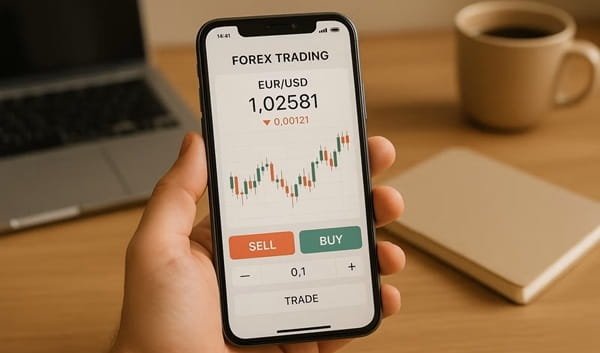
Forex trading apps have made currency-market access much easier for individual traders. With a smartphone, users can view currency prices, analyse charts, place orders and monitor positions. However, convenience also creates risks. Not every app advertising forex trading to Indians is authorised to provide such services.
For Indian residents, choosing a forex trading app should begin with regulatory verification, not attractive returns, high leverage or promotional offers. The Reserve Bank of India (RBI) states that resident persons may undertake forex transactions only with authorised persons and for permitted purposes. Permitted electronic forex transactions should be conducted through RBI-authorised Electronic Trading Platforms (ETPs) or recognised stock exchanges such as NSE, BSE and MSE.
1. Check Whether the Platform Is Authorised
The most important step is checking the regulatory status of the platform.
A professional-looking website or mobile application does not prove that it is authorised in India. Before depositing money, identify the actual legal entity operating the app and verify its regulatory status.
For exchange-traded currency derivatives, investors can check SEBI’s registered-intermediary database. SEBI maintains a specific list of stock brokers registered in the currency-derivatives segment.
The RBI also maintains information about authorised Electronic Trading Platforms. Under its framework, an entity cannot operate an ETP for eligible instruments without prior RBI authorisation.
This distinction is important because an app may provide access to financial products but still not be authorised to offer particular forex transactions to Indian residents.
2. Do Not Rely Only on the RBI Alert List
The RBI publishes an Alert List containing entities that are not authorised to deal in forex under FEMA or operate forex ETPs under the relevant RBI framework.
However, the RBI specifically warns that the Alert List is not exhaustive. An entity not appearing on the list should not automatically be assumed to be authorised. Instead, users should verify the entity against the appropriate lists of authorised persons and authorised ETPs.
This is a crucial safety rule.
If an app is absent from the Alert List, that alone is not proof of legitimacy.
3. Understand What the App Actually Offers
The term “forex trading app” can describe very different products.
An app may provide:
- Currency futures
- Currency options
- Spot foreign-exchange services
- International forex contracts
- CFDs
- Other leveraged derivatives
These products are not automatically interchangeable from a regulatory perspective.
Before opening an account, determine exactly what financial product you are trading, which legal entity provides it and which regulator oversees it.
An app offering EUR/USD or GBP/USD through an offshore CFD structure, for example, should not automatically be treated as equivalent to trading permitted currency derivatives through an Indian recognised exchange.
4. Verify the Broker, Not Just the App
An app is simply the technology interface. The more important question is who operates the account behind it.
Look for the broker’s:
- Full legal name
- Registration number
- Registered office
- Regulatory authority
- Exchange memberships
- Customer-support details
- Terms and conditions
- Grievance-redressal mechanism
Then independently verify those details through the regulator’s website.
Do not rely solely on a registration number displayed inside an app or on a promotional website.
SEBI’s database allows users to search registered intermediaries by name, trade name and registration number.
5. Be Careful With High-Leverage Promises
High leverage is frequently used to attract inexperienced traders.
An app may advertise extremely high leverage, suggesting that a small deposit can control a very large position.
However, leverage increases exposure to losses as well as potential gains. A relatively small market movement can significantly affect a highly leveraged position.
Therefore, “higher leverage” should never be treated as evidence that an app is better.
A safer evaluation focuses on regulation, product suitability, transparent costs and risk controls.
6. Check All Trading Costs
Before selecting an app, understand its complete pricing structure.
Possible costs include:
- Bid-ask spreads
- Brokerage or commissions
- Exchange charges
- Taxes and statutory charges
- Currency-conversion costs
- Account-related fees
- Financing or overnight charges, where applicable
An app advertising “zero brokerage” may still have other costs.
For active traders, even small differences in spreads and transaction charges can become significant over time.
Rather than comparing only the headline brokerage figure, calculate the approximate total cost of opening and closing a typical position.
7. Look for Strong Account Security
Financial apps should have appropriate security measures.
A reliable platform should normally support features such as:
- Strong password protection
- Two-factor authentication
- Secure login
- Device or session controls
- Transaction alerts
- Secure payment mechanisms
Users should also avoid sharing passwords, PINs, OTPs or authentication codes with anyone claiming to be a broker representative.
A legitimate trading platform should not require customers to reveal one-time authentication codes over a phone call or messaging application.
8. Be Suspicious of Guaranteed Returns
One of the clearest warning signs is a promise of guaranteed forex profits.
Statements such as:
- “Guaranteed 10% daily returns”
- “Risk-free forex income”
- “Fixed monthly profits”
- “Our AI never loses”
- “Double your money quickly”
should immediately raise concerns.
Currency markets are uncertain, and legitimate trading platforms cannot guarantee that customers will make profits.
The RBI has specifically warned about unauthorised entities offering forex trading facilities to Indian residents while promising disproportionate or exorbitant returns.
9. Avoid Pressure to Deposit More Money
Scam platforms may initially allow small withdrawals to build trust. Later, users may be pressured to deposit larger amounts to access supposed premium accounts, higher profits or withdrawals.
Other warning signs include:
- Pressure to deposit immediately
- “Limited-time” investment offers
- Personal account managers demanding payments
- Unexplained withdrawal fees
- Requests to transfer money to personal bank accounts
- Cryptocurrency-only deposits
- Promises of recovery after losses
If an app repeatedly pressures you to send additional funds, stop and independently investigate the platform.
10. Be Careful With Social Media Promotions
Many trading apps are promoted through Instagram, YouTube, Telegram, WhatsApp and other social-media channels.
An influencer’s recommendation does not establish regulatory authorisation.
Before downloading an app promoted online, independently verify the company and regulatory information.
The RBI Alert List also includes certain entities and platforms involved in promoting unauthorised forex platforms, demonstrating why promotional claims should not be treated as proof of authorisation.
11. Understand India’s Rules on Overseas Forex Platforms
This is particularly important for Indian residents.
The RBI states that residents cannot use unauthorised ETPs for forex transactions. It also states that remittances under the Liberalised Remittance Scheme cannot be made for margin payments to overseas exchanges or overseas counterparties for online forex trading.
Therefore, an overseas forex app accepting Indian customers should not automatically be considered legally suitable for an Indian resident.
The RBI has specifically advised residents to deal in forex only with authorised persons and on authorised ETPs.
12. Check Customer Support and Complaints Process
Before depositing money, find out how complaints are handled.
A legitimate financial intermediary should provide clear information about customer support and grievance redressal.
For regulated Indian intermediaries, users should understand the applicable complaint mechanism and escalation process.
Avoid platforms that provide only anonymous Telegram or WhatsApp contacts without a clearly identifiable legal entity.
A Simple Safety Checklist
Before choosing a forex trading app in India, ask:
| Check | What to Verify |
| Regulation | Is the relevant entity authorised? |
| Broker identity | What is its full legal name? |
| Product | What exactly are you trading? |
| Exchange | Is the product offered through a recognised exchange where applicable? |
| RBI status | Is the platform an authorised ETP where required? |
| SEBI status | Is the intermediary registered for the relevant segment? |
| Costs | What are the complete trading charges? |
| Security | Does the app offer strong account protection? |
| Withdrawals | Are withdrawal rules clear? |
| Promotions | Are there guaranteed-profit claims? |
| Funding | Where exactly does your money go? |
Conclusion
Choosing a forex trading app safely in India requires much more than comparing interfaces, leverage or promotional offers. Regulatory authorisation should be the first filter.
Indian residents should verify the actual broker or platform through official RBI and SEBI information, understand the exact forex product being offered and confirm that the transaction is permitted under India’s applicable rules.
The RBI makes clear that residents may undertake forex transactions only with authorised persons and for permitted purposes, while electronic forex transactions must use authorised ETPs or recognised exchanges under the applicable framework.
Users should also examine spreads, commissions, security features, withdrawal procedures and customer support. Most importantly, they should avoid platforms promising guaranteed returns or pressuring them to deposit money quickly.
A good forex trading app is not necessarily the one offering the highest leverage or lowest advertised cost. For an Indian trader, the safer starting point is a platform whose regulatory status, legal entity, product and charges can all be independently verified.